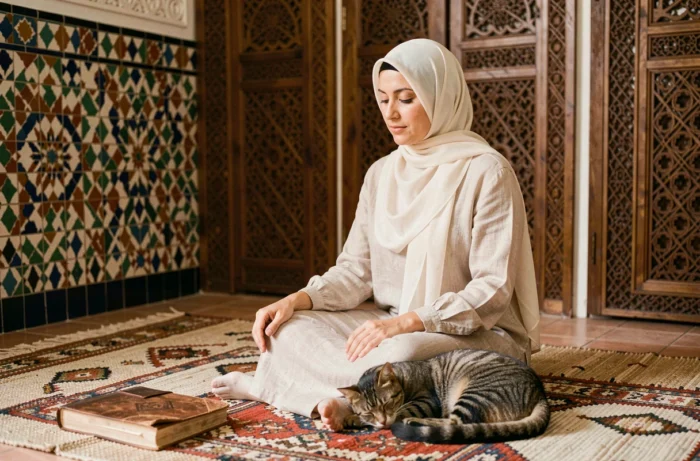
In Islamic tradition, dreams are not merely a residue of the day. They are classified into a precise typology, inherited from prophetic hadiths, which distinguishes true visions (ru’yā), disturbing dreams attributed to Shaytān (hulm), and dreams arising from personal concerns.
When a cat appears in this context, the interpretation cannot be reduced to a dictionary of symbols. The dreamer’s context, spiritual state, and details of the dream guide the interpretation in sometimes opposing directions.
Ru’yā, hulm, and personal thoughts: the filter before any interpretation of the cat dream
Most online articles offer fixed lists of symbols: black cat = betrayal, white cat = purity, kitten = infatuation. This approach ignores the methodology that contemporary guides of ta’bīr (dream interpretation) insist upon.
A dream in Islam falls into three distinct categories. Ru’yā is a true vision, considered to come from Allah. Hulm is a disturbing dream, often associated with Shaytān. The third category encompasses dreams born from the thoughts and concerns of the sleeper, without any particular spiritual significance.
Before seeking what a cat means in your dream, the preliminary question concerns the very nature of the dream. A cat seen after a day spent with animals likely does not carry the same weight as a feline appearing in a significant dream, accompanied by strong emotion upon waking. Scholars remind us that the symbol alone is never sufficient to establish an interpretation.
To delve into the meaning of the cat dream in Islam, one must cross-reference several interpretative frameworks: the Quran, the Sunnah, Arabic proverbs, the meanings of names, and sometimes the opposite meaning of the apparent symbol.

Cat in Islam: an animal with a special status in hadiths
The cat holds a unique place among animals in prophetic tradition. Unlike the dog, whose status is subject to known restrictions, the cat is associated with kindness and ritual cleanliness. Prophet Muhammad is said to have shown a particular attachment to this animal on several occasions, which directly influences how its presence in a dream is received.
This historical dimension explains why dreaming of a cat is not automatically a bad sign. However, the cat’s behavior in the dream radically alters the interpretation.
- A calm and affectionate cat is generally read as a sign of protection, gentleness, or benevolent companionship in the dreamer’s surroundings.
- An aggressive cat, scratching or biting, directs the interpretation towards the presence of a hostile person or deceit in the dreamer’s life.
- A stray or sick cat may refer to personal vulnerability, a fragile project, or an aspect of spiritual life that is neglected.
- A dead cat in the dream elicits divergent readings among interpreters, ranging from the end of a threat to the loss of an emotional bond.
The dreamer’s context (man or woman, life situation, state of religious practice) weighs as heavily as the symbol. Field reports vary on this point: some interpreters emphasize the feminine dimension of the cat, while others reject this reduction.
Color of the cat in the dream: what tradition really retains
The color of the fur is one of the most sought-after elements by internet users. The black cat crystallizes questions, often contaminated by superstitions external to Islam.
In the Islamic interpretative framework, the black cat refers to concealment or a person whose intentions remain opaque. This reading does not make the black cat an omen of misfortune in itself. Rather, it points to a blind spot in the dreamer’s relationships, something that escapes their conscious perception.
The white cat is often read as a symbol of clarity or sincerity. A tabby or multicolored cat introduces ambiguity that the interpreter must untangle based on other elements of the dream.
A warning against superstitions
Contemporary Muslim educators increasingly alert against superstitious deviations related to animals and dreams. The notion of tasha’um (bad omen derived from an animal or event) is explicitly classified as a form of minor shirk in current theological argumentation. Believing that a black cat in a dream mechanically predicts an accident or betrayal falls into this category.
Content circulating on social media amplifies these simplistic associations. A dream of a black cat does not condemn the dreamer to permanent mistrust, just as a white cat does not guarantee a period of grace.
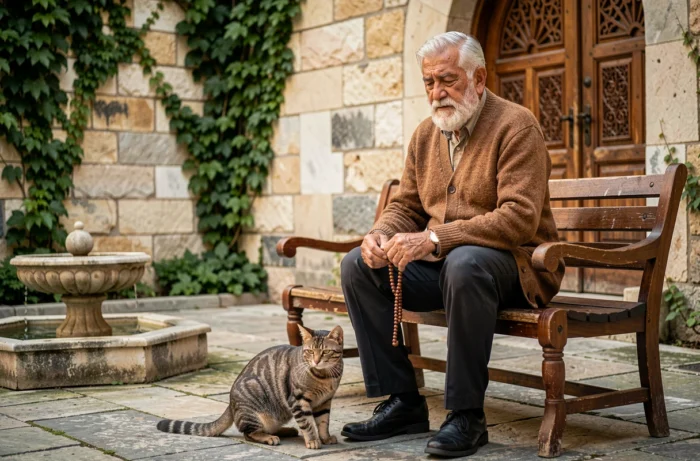
Cat dream and personal life: interpretations that withstand scrutiny
Among recurring interpretations, some are based on solid textual foundations while others are more folkloric.
The reading of the cat as a figure of feminine intuition frequently arises. It relies on ancient cultural associations, but the available data do not allow it to be linked to a specific hadith. Reliable interpretation always intersects the symbol with the dreamer’s experience.
A cat entering a house in a dream may evoke the arrival of a person in the dreamer’s life, or a change in the intimate space. A cat that flees may signal a loss, a distancing, or the end of a familiar situation.
What emerges from serious ta’bīr guides is that the interpretation of a cat dream cannot be automated. The same dream image, presented to two different interpreters, can yield two distinct readings if the dreamer’s context differs.
The cat dream in Islam functions as a partial mirror. It does not mechanically predict the future. It invites the dreamer to examine an aspect of their life, a relationship, a fear, or a hope, through the prism of an animal that Islamic tradition treats with unusual respect among everyday creatures.