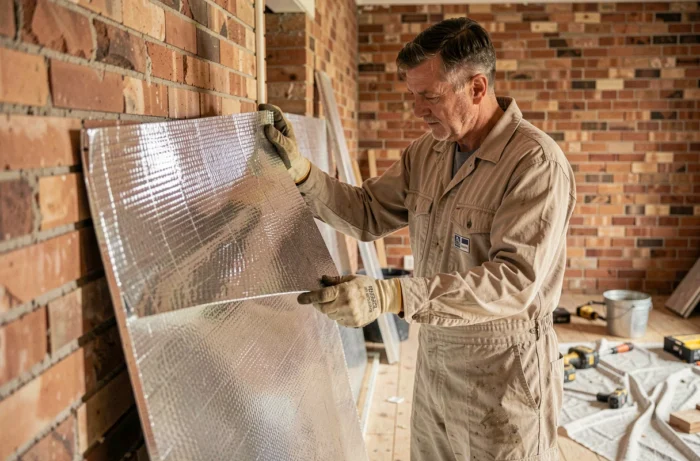
A thin insulation refers to a product whose total thickness does not exceed a few centimeters, made up of layers stacked between two reflective aluminum films. Its thermal resistance remains low compared to traditional insulations: most reflective thin products achieve an R value between 0.5 and 2 m².K/W, where current regulations require much more for interior walls. Understanding this technical limit before making a purchase avoids costly mistakes.
Thermal resistance R and regulatory threshold: the criterion that eliminates most thin insulations
The classification of an insulation depends on its thermal resistance R, expressed in m².K/W. The higher this number, the more the material slows down heat transfer. For interior walls, the minimum threshold set for 2026 to qualify for energy renovation aid is R ≥ 3.7 m².K/W.
A typical reflective thin product (PMR), even multilayered, generally caps well below this threshold. ADEME reminded at the end of 2025 that a thin insulation for interior walls cannot replace traditional insulation for opaque walls. The agency positions it as a complement, not as a primary solution.
In practical terms, installing a PMR alone on an interior wall does not qualify for any financial aid such as MaPrimeRénov’ or Prime CEE. Only an insulation reaching R ≥ 3.7 qualifies for aid for walls. This point immediately eliminates the majority of multilayer thin insulations used without backing.
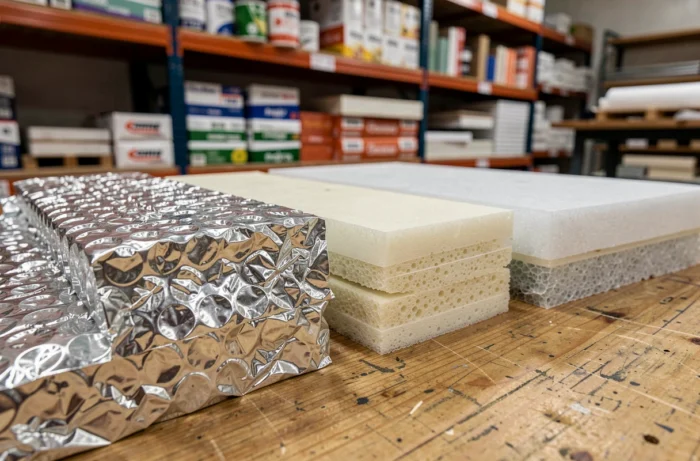
High-performance low-thickness insulations: polyurethane, PIR, and vacuum panels
To insulate an interior wall while minimizing space, one should turn to materials with very low thermal conductivity rather than reflective PMRs. Three families stand out for their performance/thickness ratio.
Polyurethane (PUR) and polyisocyanurate (PIR)
Polyurethane PUR has one of the lowest thermal conductivities among common insulations. Polyisocyanurate (PIR), a variant of PUR, offers comparable performance with better fire resistance. Both come in rigid panels a few centimeters thick.
With these materials, achieving R 3.7 requires a thickness significantly lower than that required by standard glass wool. The gain in usable space is real, especially in narrow rooms or older homes where every centimeter counts.
Vacuum Insulation Panel (VIP)
Vacuum insulation panels represent the thinnest solution on the market. Their thermal conductivity is several times lower than that of polyurethane. In return, their price remains significantly higher, and their installation requires precautions: any perforation of the VIP panel cancels the vacuum effect and degrades its performance.
This type of panel is justified in very constrained configurations (thick load-bearing walls to preserve, classified old buildings, small rooms).
Condensation risk and water vapor management in interior walls
Competitors rarely address the issue of water vapor in detail, even though it conditions the durability of any thin insulation installed on the interior side. A reflective thin insulation, due to its airtight structure (aluminum films), blocks the migration of water vapor to the outside of the wall.
If the installation does not provide a ventilated air gap between the insulation and the cold wall, moisture condenses at the interface. The consequences are predictable:
- Appearance of mold between the wall and the insulation, invisible until the covering is removed
- Progressive degradation of the load-bearing wall (blistering plaster, weakened joints, capillary migration)
- Loss of thermal performance of the insulation itself, as its conductivity increases with absorbed moisture
Therefore, installing a PMR requires a air gap on each side of the product, which adds to the total thickness of the insulation complex and reduces the claimed space gain. This implementation detail sometimes changes the calculation: a rigid PUR panel glued directly to the wall with an appropriate vapor barrier can prove to be more compact than a PMR properly installed with its two air gaps.
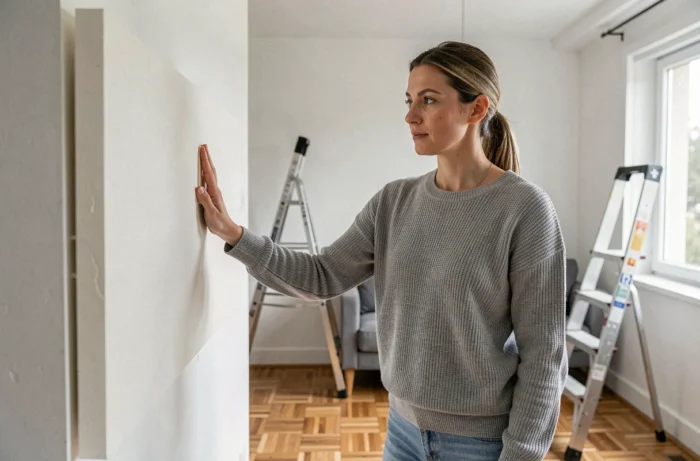
Choosing a thin insulation for interior walls: concrete decision criteria
The choice is not limited to comparing technical sheets. Several practical parameters guide the decision based on the housing situation.
- The target thermal resistance: if the wall is already partially insulated and a supplement is sufficient, a PMR may be suitable. If the insulation starts from scratch, a PUR or PIR panel will be more appropriate to reach the regulatory threshold
- Eligibility for aid: without reaching R 3.7 m².K/W, no grants are accessible. This criterion excludes most PMRs used alone
- The condition of the supporting wall: a damp wall or one subject to capillary rise does not support a vapor-tight insulation well. A prior diagnosis of humidity is necessary before any installation
- The overall budget: the cost of the material alone is not enough. PMRs may seem affordable per square meter, but the framework, air gaps, and finishing increase the bill. A glued PUR backing + plasterboard may end up costing a comparable amount for superior thermal results
A thin insulation remains relevant as a thermal supplement in specific configurations: backing an existing insulation that is slightly insufficient, addressing a localized thermal bridge, or insulating an unheated space where regulatory requirements are lower. Used alone on an interior wall to be insulated, it does not replace a high-performing traditional insulation.
The final choice therefore depends less on the material itself than on the configuration of the wall, the thermal objective pursued, and the willingness or not to mobilize financial aid. Asking about the target R value before comparing products avoids ending up with undersized insulation, no matter how thin it is.