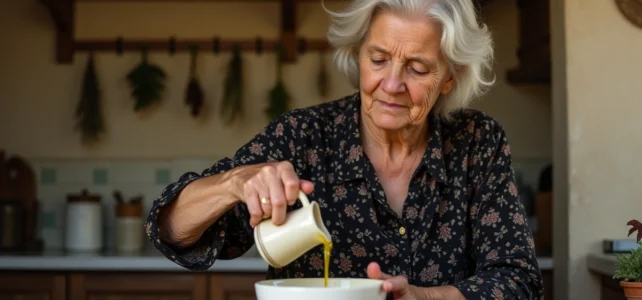
The olive oil ritual against the evil eye is one of the most widespread practices in the Mediterranean basin. Depending on the regions and families, the method varies significantly in its gestures, supports, and conditions of execution.
What seems to be a unique ritual actually encompasses several variants whose parameters differ on specific points: the container used, the number of drops poured, the time of day, or even the profile of the person authorized to officiate.
Regional Variants of the Olive Oil Ritual Against the Evil Eye
Comparing practices from one region to another reveals significant discrepancies in the conditions of the ritual. The table below summarizes the main documented differences.
| Parameter | Corsican Tradition (Ochju) | Southern Italian Tradition | Greek Tradition |
|---|---|---|---|
| Container | Deep plate filled with water | Plate or bowl of water | Glass of water |
| Number of Drops | Three drops, sometimes just one | Three to five drops | Variable according to families |
| Who Can Practice | Initiated person within the family | Elder woman of the family | Elder of the village or family |
| Preferred Moment | Often at dusk | No fixed time | No fixed time |
| Associated Prayer | Yes, transmitted orally | Yes, often in dialect | Yes, short formula |
In Corsica, the oil used is considered a holy oil reserved for the ritual, kept separately and transmitted with specific rules regarding its storage. This detail clearly distinguishes the Corsican practice from other traditions where the oil remains that of daily use.
Family transmission is a common point, but the modalities differ. In some Corsican families, the ritual can only be taught on a specific date of the year. In Southern Italy, the passing down is done more freely among women of the lineage.
Those seeking to neutralize the evil eye with olive oil benefit from identifying the tradition from which their ritual originates, as the gestures and interpretations change from one variant to another.
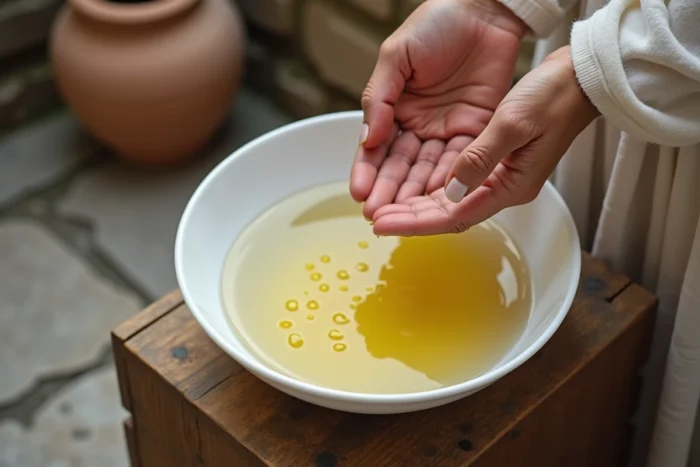
Reading the Result: Interpreting the Behavior of Oil Drops in Water
The basic principle remains the same everywhere: drops of olive oil are placed on the surface of a container filled with water, and then their behavior is observed. The reading of the result relies on two main scenarios.
- The drops remain separate and distinctly float on the surface: according to tradition, this indicates an absence of the evil eye or an energy considered healthy
- The drops merge, spread out, or sink to the bottom: this behavior is interpreted as a sign of active evil eye on the tested person
- The drops take an elongated shape or fragment into micro-droplets: some practitioners see this as an indicator of intensity, a deeper affliction requiring the ritual to be repeated
The merging of the drops is the most frequently cited sign confirming the evil eye. However, it should be nuanced: the temperature of the water, the quality of the oil, and even the height from which the drops are poured influence how the oil behaves physically on the surface.
None of these interpretations are based on scientific validation. The ritual falls under a traditional and spiritual practice whose value is symbolic and cultural.
When to Repeat the Olive Oil Test
In most traditions, if the first result indicates an evil eye, the ritual is repeated three times in a row. Some families redo the test the next day, and then the day after, to check that the drops behave normally again.
A Corsican practitioner believes that the ritual loses its effectiveness if practiced too frequently without reason, which aligns with the idea of not trivializing the gesture.
Storage of Olive Oil Used for the Ritual: An Often Overlooked Parameter
Contents on spiritual protection rarely mention a point documented by traditional producers and mills: the quality of the oil itself. Rancid olive oil, exposed to light or poorly sealed, loses its organoleptic properties. Symbolically, several traditions consider that altered oil no longer fulfills its purification function.
- Use a recent oil, protected from light and properly sealed
- Do not store the ritual oil in a transparent container or near a heat source
- In Corsica, the holy oil is often kept in a dedicated opaque bottle, never mixed with cooking oil
- Check the smell before each use: oil that smells rancid has lost its freshness
This concern for preservation is not trivial. It reflects an internal coherence of the ritual: if olive oil is chosen for its symbolic charge of purity, using degraded oil contradicts the very logic of the practice.

Complementary Approaches to the Olive Oil Ritual: Salt, Plants, and Psychological Dimension
The olive oil ritual does not exist in isolation. Recent content in spirituality documents a growing hybridization of Mediterranean, Mesoamerican, and African traditions. Specifically, some people combine olive oil with salt, sage, rue, or amulets like the nazar.
Salt is the most frequent addition. Placed around the plate or dissolved in the test water, it is supposed to amplify the purifying effect. Rue, a plant used in Latin American and Mediterranean traditions, sometimes accompanies the ritual in the form of a branch passed around the body.
Protection and Psychological Well-Being
Practitioners of energy protection now integrate practices of meditation, sophrology, and conscious breathing into traditional rituals. The idea is that neutralizing the evil eye does not rely solely on the gesture with the oil, but also on a work of distancing from toxic relationships and personal re-centering.
This mixed approach does not replace the ritual for those who believe in it, but it adds a dimension of stress management that can be beneficial regardless of any spiritual belief.
The boundary between symbolic practice and psychological support remains porous. The ritual gesture offers a structured framework, a moment of pause and self-attention, which, for some people, produces a measurable calming effect on an emotional level, even outside of any adherence to the associated beliefs.