
The Spanish sales no longer work like they did ten years ago. The gradual liberalization of commercial calendars and the rise of e-commerce have blurred the line between official sales and permanent promotions. A shopper arriving in Madrid or Barcelona unprepared may end up paying more during sales than at regular times, simply because they do not check the right channel at the right time.
Reference prices and fake discounts: the Spanish legal framework for sales
Spanish regulations require retailers to display the lowest previous price charged in the 30 days prior to the discount. This mechanism, aligned with the European Omnibus directive, theoretically protects against artificial inflation. In practice, the displayed reference price is not always the actual market price.
The most common trap concerns stores that run flash promotions a few weeks before the sales, then revert to the catalog price to later display a spectacular discount. The percentage shown in the window is technically legal, but the actual reduction compared to the most recent lowest price may be marginal.
We recommend noting the prices of items spotted at least three weeks before the official start of the sales. Several common mistakes made by French tourists are documented on the La Petite Emma website, particularly this tendency to rely solely on the displayed percentage without checking the pricing history.
One often overlooked point: as a European citizen, you enjoy exactly the same warranty and return rights as Spanish consumers. The return conditions during sales remain the same as during the rest of the year, unless explicitly and visibly stated otherwise in the store.

Compare online before buying in Spanish stores
The growth of online shopping in Spain is radically changing the way physical sales are approached.
Fashion is the sector where the digital channel has the most weight. CaixaBank Research notes that about one-third of fashion spending goes through digital channels, and about one in five consumers primarily buys their fashion items online. In practice, the price you see in-store on Gran Vía is not necessarily the best price available for the same item.
The reflex to adopt systematically:
- Check the price of the same item on the Spanish website of the brand (zara.com/es, mango.com/es), not on the French version which sometimes applies different rates
- Compare shipping costs: some brands offer free shipping in Spain from a low threshold, making online purchases more advantageous than in-store purchases with travel costs
- Check the return conditions online, which are often more flexible (14 days of legal withdrawal for e-commerce compared to a variable policy in physical stores)
This strategy of spotting in-store then buying online has become common among Spanish consumers themselves. Ignoring it means missing out on real savings.
Crowds in shopping malls: when Spanish sales work against you
Foot traffic in Spanish shopping malls has significantly increased in recent months. According to Sensormatic Solutions, foot traffic in physical stores has notably progressed during peak periods.
This influx has two direct consequences for French tourists. First, the best sizes and colors disappear in the first hours of the initial markdowns. Spanish consumers, accustomed to the system, position themselves as soon as the doors open. Arriving the weekend after the launch means inheriting the residual stock.
Secondly, the pressure at the checkout and in the fitting rooms leads to impulsive purchases. In a saturated environment, the reflex for compulsive buying is triggered more easily. We observe that tourists who have not established a precise list before entering the store spend significantly more than expected, often on items they would not have looked at under normal circumstances.
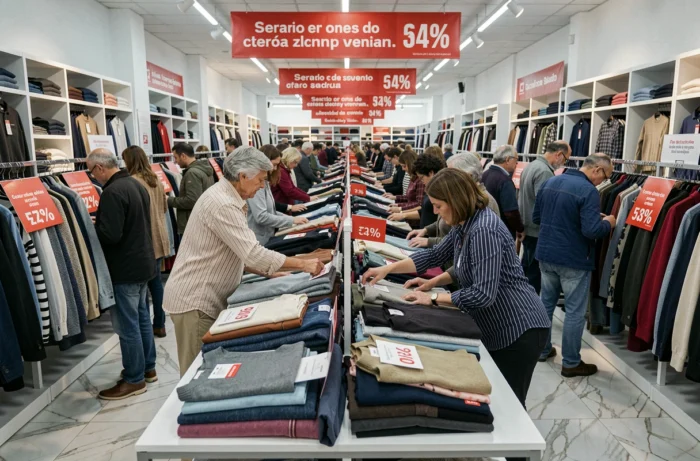
Actual markdown calendar
Winter sales generally start on January 6 in Spain, but the third markdown often offers the best discount/availability ratio. The first two weeks concentrate crowds and moderate discounts. The last weeks display high percentages but on depleted stock.
The ideal window is between the second and third week of sales. Discounts then reach a substantial level while the selection remains decent, especially in large textile stores (El Corte Inglés, Primark, Springfield).
Permanent promotions and sales: distinguishing the real from the fake
The proliferation of commercial operations outside of sales (Black Friday, Mid-Season Sale, online private sales) has diluted the real advantage of the rebajas. According to observations from Conferco reported by Diario de León, a discounted price is not necessarily lower than a previous promotion.
This phenomenon particularly affects fast fashion brands, which renew their collections at such a pace that discounted items are sometimes end-of-line products that were already discounted a few weeks earlier under a different promotional guise.
For significant purchases (leather goods, branded shoes, electronics), checking the price on Spanish comparison sites like Idealo.es or Kelkoo.es before finalizing a purchase in-store remains the most reliable method. An item displayed at less than forty percent in the window may very well have been available at the same price online three weeks earlier.
Spanish sales remain a real opportunity, provided they are approached methodically. The main trap is neither the calendar nor the quality of the products: it is the gap between the perceived discount and the actual discount, which only systematic comparison can measure.