
The stroller market has become more complex in recent years with the increase in configurations: trio, duo, standalone chassis, ultra-compact stroller. For parents preparing for the arrival of a baby, the choice is no longer limited to just budget or design considerations.
The European standard EN 1888, the compatibility rules between chassis and car seats, and the shift towards regulation UN R129 (i-Size) for infant carriers are significantly changing the selection criteria for a stroller and its accessories.
Compatibility of trio adapters: a model-by-model check
Trio packs (chassis, carrycot, car seat) are appealing for their practicality: one purchase, one brand, components that are supposed to fit together without issue. The reality is more nuanced.
Field feedback shows that compatibility must be checked separately for each component, even within the same brand. Two closely related ranges may use different attachments for the chassis and the shell. An adapter designed for a specific model of stroller may not necessarily work with the next version from the same manufacturer.
This point is rarely detailed in general buying guides, which merely recommend a “compatible” trio pack. Before purchasing, it is advisable to check the exact reference of the adapter and physically test the clipping in-store. Parents assembling their equipment can also learn more on Excargot net to compare available references by chassis model.

Standard EN 1888 and CE marking: what compliance really guarantees
The EN 1888 standard governs the safety of strollers sold in Europe. It covers material strength, chassis stability, braking and restraint systems. However, compliance with EN 1888 does not mean a CE marking is required for a non-motorized stroller. Confusion is common.
The CE marking applies to toys, certain electrical equipment, and medical devices. A classic stroller without a motor does not fall into these categories. Its compliance relies on the manufacturer’s voluntary adherence to the EN 1888 standard, often verified by an independent laboratory.
What the standard does not cover
EN 1888 does not address compatibility between accessories from different brands. It also does not mention the durability of textiles, UV resistance, or ease of cleaning. These aspects depend on the manufacturer’s choices and user feedback.
For parents purchasing a car seat as an addition, it is the UN R129 (i-Size) standard that applies to shells and car seats, not EN 1888. The two standards cover distinct products, even when sold together in a trio pack.
Trio stroller or compact chassis: deciding based on actual use
The question deserves to be asked frankly: should one still buy a trio pack, or is it better to choose a compact chassis and select the carrycot and car seat separately?
The trio remains relevant in a specific case: parents who want a coherent set from birth, with a carrycot approved for sleep and a compatible car seat, all on a single chassis. The time saved at purchase is real, and the overall cost is often lower than buying three products separately.
On the other hand, the compact chassis purchased alone offers more flexibility in the long term. Current compact strollers fold to cabin size, weigh significantly less than a trio chassis, and often accept car seats from different brands via universal adapters. For primarily urban use, with public transport and small trunks, this option prevails.
The limitations of the trio in daily use
- The carrycot, used only for the first few months, then takes up significant storage space without being reusable for another purpose
- The trio chassis is generally heavier and bulkier than a compact chassis, complicating outings in the city and storage in an apartment
- Reselling a complete trio pack is more difficult than selling separate components, as the buyer must want exactly the same configuration
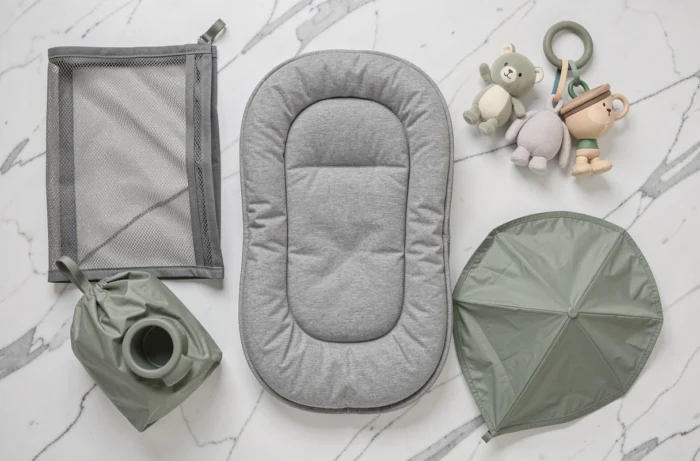
Stroller accessories: distinguishing the essentials from the superfluous
The range of accessories has significantly expanded: rain cover, footmuff, handlebar organizer, sunshade, adapter for a skateboard, cup holder. The natural reflex is to add everything to the cart. Most of these accessories will only be used a few times.
Three accessories justify a priority purchase: the rain cover (often included, otherwise it must be purchased), a footmuff suitable for the season of birth, and a diaper bag that attaches to the handlebar. The rest can wait until the need actually arises.
- The rain cover must match the exact model of stroller; “universal” versions often allow water to seep through at the joints
- The footmuff must be compatible with the safety harness of the seat; check the openings for the straps before purchasing
- The diaper bag that attaches to the handlebar should not unbalance the stroller once loaded; test with weight in-store
Car seat and stroller: two standards, two safety logics
Parents purchasing a car seat in a trio pack must ensure that this seat complies with the UN R129 (i-Size) standard, which requires rear-facing installation for infants. The older ECE R44/04 standard, still present on some models in circulation, is being gradually replaced.
Compatibility between the shell and the vehicle’s Isofix base is verified independently of compatibility with the stroller chassis. A car seat can perfectly clip onto a stroller without being compatible with the Isofix base of a given car model. These are two distinct fastening systems.
The available data does not allow for a conclusion that a trio pack systematically guarantees better compatibility than a separate assembly. Each configuration requires its own verification, consulting the compatibility list from the car seat manufacturer and that of the chassis.
The choice of a stroller in 2024 relies less on the brand or design than on the concrete verification of compatibilities between components, compliance with current standards, and suitability for actual daily use. A chassis tested in-store with the intended car seat and carrycot remains the most reliable method to avoid unpleasant surprises after purchase.