
You just transported your refrigerator lying flat in a van and you’re eager to plug it back in to save your groceries. The problem is that the compressor oil has migrated into the refrigeration circuit during the trip. Plugging it back in too soon risks a mechanical failure that can sometimes be irreversible.
What happens in the circuit when a fridge travels on its side
The compressor of a refrigerator works somewhat like an engine: it needs oil to lubricate its moving parts. In a vertical position, this oil stays at the bottom of the compressor, where it should be.
When the appliance is lying down, gravity pushes the oil into the tubes of the refrigeration circuit. It can even reach the condenser or the evaporator. If you plug it back in at that moment, the compressor runs without proper lubrication. The metal parts rub against each other dry.
Before knowing how long to let a fridge lie down how long to wait, it is essential to understand that the waiting period is solely to allow the oil to flow back down to the compressor by gravity. No shortcuts are possible: physics does not negotiate.

Rest period according to the brand and transport angle
Manufacturers do not all provide the same instructions, and the differences can be quite significant. Here’s what the manufacturer manuals actually recommend.
Transport standing with slight tilt
If your fridge was only tilted briefly (to go through a door or down a staircase), a few hours of rest is generally sufficient. Bosch recommends a minimum of 4 hours in this case. Liebherr asks for about 6 hours for a tilt of around 45 degrees.
Transport lying flat
This is the riskiest situation. The oil has had plenty of time to disperse far from the compressor. The recommendations increase significantly:
- Bosch recommends up to 24 hours of rest after lying down transport.
- Whirlpool systematically requires 24 hours before the first plug-in, even after lying down transport.
- Liebherr goes up to 48 hours of waiting after flat transport, making it the strictest brand on this point.
- Samsung recommends at least 12 hours after any movement, without specific position distinction.
This table shows a considerable gap, from 12 to 48 hours depending on the manufacturer. Always consult the manual for your model before relying on generic advice.
American fridge or model with ice maker
Side-by-side or French door refrigerators have more complex circuits. The refrigerant and oil have more distance to travel to return to their place. For these models, manufacturers generally recommend between 24 and 48 hours of rest after lying down transport.
How to speed up (a little) the return of the oil to the compressor
You cannot cheat gravity, but you can avoid unnecessarily extending the waiting period.
Upright the fridge as soon as you arrive and ensure it is straight. Every minute spent lying down after transport prolongs the dispersion of the oil. A device repositioned vertically immediately starts to “recover” right away.
Place it in a room with normal ambient temperature. Cold outside thickens the oil and slows its flow. If you move in winter and the fridge waits in an unheated garage, the oil will take longer to return.
Do not tilt the appliance from one side to the other hoping to “make the oil flow” faster. You risk further dispersing it in the circuit instead.
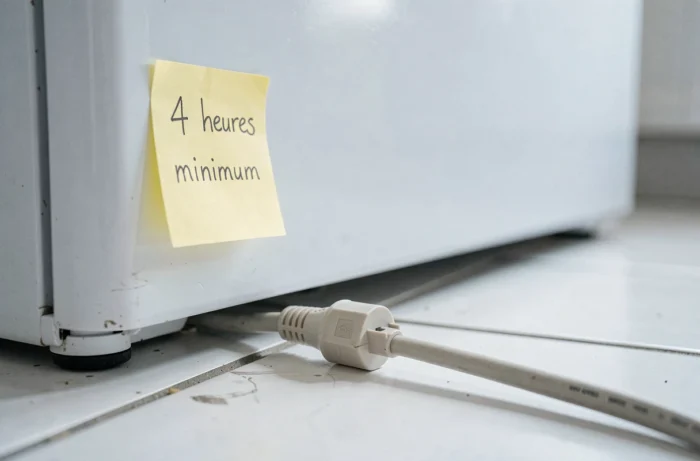
Warning signs after plugging the refrigerator back in
You have waited the recommended time, the fridge is plugged back in. Not everything is won yet. The first hours of operation allow you to spot a problem.
A clicking or repetitive banging noise coming from the compressor indicates that it is struggling to start. This may mean that the oil has not fully returned to its position. In this case, unplug immediately and wait several more hours before trying again.
A compressor that runs continuously without the interior temperature dropping is another concerning signal. The refrigerant may not be circulating well due to a residual oil blockage in the circuit.
The interior temperature should gradually decrease within the first 2 to 3 hours after plugging in. If the fridge remains warm after this period, something is wrong.
Do not fill the refrigerator immediately. Let it run empty until it reaches its set temperature. Loading a still warm fridge with food forces it to work harder just as the compressor has just restarted.
Fridge lying on the wrong side: a more serious mistake
Not all sides are equal when laying down a refrigerator. Most models have the compressor tubing on a specific side. Laying the appliance on this side facilitates the migration of oil into the circuit.
If your manual indicates a recommended side for laying down and the transport was done on the opposite side, extend the resting time by at least 50% compared to the standard recommendation. The oil may have infiltrated deeper into areas of the circuit that are not designed to contain it.
In the absence of any indication in the manual, caution remains the best option: apply the maximum waiting time recommended by the manufacturer for lying down transport.
The most reliable reflex is to read the manual before moving, not after. If you have lost it, most manufacturers provide their manuals for free download on their website based on the model reference printed on the label inside the fridge.