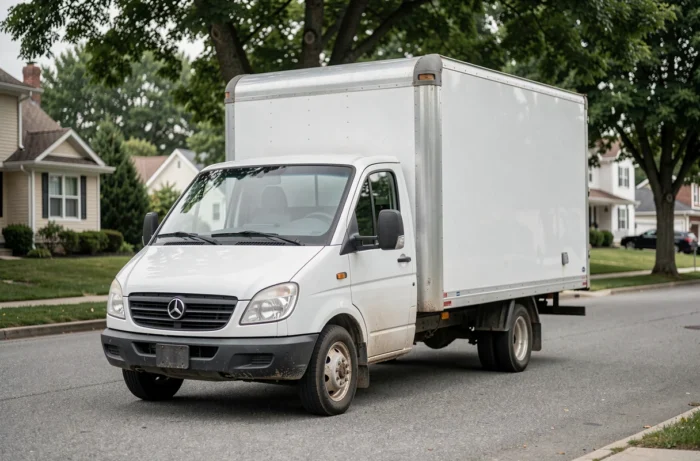
A van labeled 10 m³ does not deliver the same interior dimensions depending on the manufacturer, model, or generation. We regularly observe discrepancies of more than 20 cm in usable length between two vehicles sold under the same commercial name. Understanding these discrepancies is crucial for successful loading, especially when the stated volume is close to the limit of what you need to transport.
European pallets in a 10 m³ van: actual capacity and width constraints
The EUR/EPAL pallet (800 x 1,200 x 144 mm) remains the logistical standard in France. General articles about the 10 m³ van refer to boxes and furniture, never to pallets. This is a significant blind spot for artisans, merchants, and service providers who load on pallets daily.
The determining constraint is not the overall volume but the usable width between the wheel arches. On a short chassis like the Renault Trafic L1, this width is about 1,268 mm, which exceeds the 1,200 mm length of a European pallet loaded sideways. As a result, two pallets fit in the short version, three in the long version (L2).
When evaluating the dimensions of a 10m3 truck, think first in terms of standardized loading units rather than gross volume. Two stacked pallets of heavy goods saturate the payload well before filling the available 10 m³.
Payload versus volume: the data imposed by the registration document
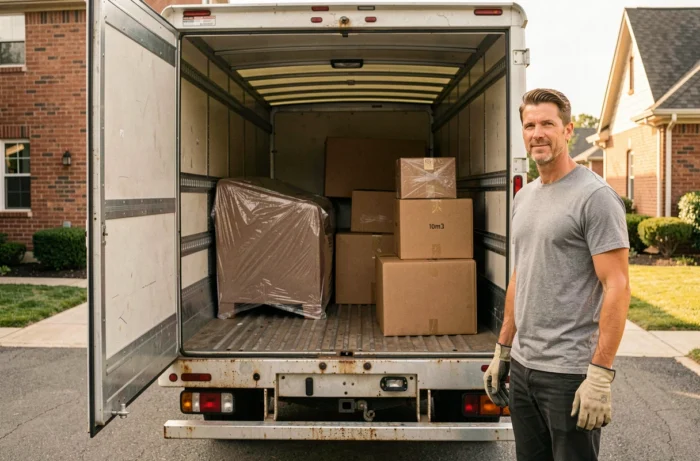
The commercial volume of 10 m³ says nothing about the transportable weight. The payload, the only regulatory data, is calculated by subtracting the empty weight (indicated on the registration document) from the GVW. Two vans displaying 10 m³ can have several hundred kilograms of difference in payload depending on equipment, engine type, and onboard options.
We recommend systematically checking field F2 (GVW) and field G1 (empty weight) of the registration document before any professional loading. Exceeding the GVW exposes you to vehicle immobilization and fines, even if the interior volume is not fully occupied.
Why weight limit before volume
A 10 m³ van filled with boxes of books or tools reaches its maximum payload while still having space in height. Conversely, a load of lightweight furniture (mattresses, clothes, small furniture) fills the volume without approaching the weight limit. The limiting factor depends on the density of the load, not the displayed volume.
Interior dimensions of a 10 m³ truck: comparison by model
Rental companies provide averages. In practice, the dimensions vary significantly from one model to another. Here are the orders of magnitude observed on the most common vans in French rental fleets.
| Data | Current Range |
|---|---|
| Interior length | 2.80 m to 3.26 m |
| Interior width | 1.75 m to 1.78 m |
| Interior height | 1.80 m to 1.84 m |
| Exterior length | about 5.90 m |
| Exterior width | about 2.42 m |
| Exterior height | about 2.61 m |
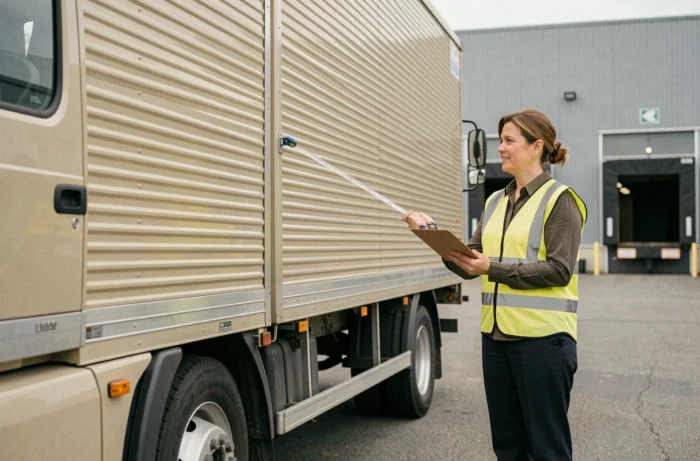
The interior length is the most variable dimension. A difference of 40 cm between a short model and a long model changes the game for a three-seater sofa or a disassembled wardrobe laid flat.
Interior height and bulky items
With a ceiling height between 1.80 m and 1.84 m, a standard refrigerator or washing machine can stand upright without difficulty. However, a wardrobe taller than 1.85 m will need to be laid down, consuming all the usable length. Anticipating the position of each bulky item avoids back-and-forth trips.
Transport capacity for a move: living space and number of trips
A 10 m³ van covers the move of a dwelling of 20 to 30 m² in a single trip, including furniture and appliances: double bed, two-seater sofa, refrigerator, washing machine, and several dozen boxes. Beyond 30 m², a second trip becomes likely, or you need to switch to a larger size (12 m³).
To estimate the number of trips required, we use a simple rule:
- Studio or T1 (up to 25-30 m²): one trip is usually sufficient, provided you disassemble bulky furniture
- Furnished T2 (40-50 m²): plan for two trips or consider a 12 m³ van if the budget allows
- Beyond 50 m²: the 10 m³ remains usable, but the number of back-and-forth trips makes the operation less cost-effective than a larger vehicle
Optimize loading to reduce trips
Space savings come from three axes: disassemble everything that can be (bed legs, shelves, table tops), load heavy items at the back and bottom to stabilize the vehicle, and then fill dead spaces with soft boxes or linens. A methodical loading can easily gain one to two cubic meters of usable space compared to random stacking.
Driving and exterior dimensions: what changes compared to a car
With an exterior length close to 5.90 m and a height of 2.61 m, the 10 m³ van remains maneuverable in the city. A B license is sufficient as long as the GVW does not exceed 3.5 tons, which is the case for almost all models offered for rent.
Points of caution focus on height clearance (underground parking, low bridges) and extended mirrors that increase the overall width. The side opening, present on most models, facilitates loading in tight spaces without having to open the rear doors wide.
The exterior dimensions remain manageable: a driver used to a minivan or an SUV can adapt in a few minutes. The main difference lies in the lack of direct rear visibility, compensated by mirrors and, on newer models, a rearview camera.