
Among the thousands of titles listed in specialized databases, the letter C encompasses a range of mangas that covers almost all editorial genres. Action shonen, psychological seinen, romantic shojo, heritage narratives: this simple initial is enough to illustrate the diversity of the French manga market, structured by increasingly segmented collections rather than by simple sales rankings.
Heritage titles in C that current selections overlook
The most consulted lists consistently highlight City Hunter or Card Captor Sakura. These titles deserve their place, but they overshadow more discreet works that have nonetheless marked the history of the medium.
Clover, published by the studio CLAMP, remains absent from most mainstream selections. This manga, recognizable for its experimental layout and nearly silent full pages, has influenced an entire generation of mangaka graphically. Its status as an unfinished series gives it a unique character in the CLAMP catalog, which is better known for Cardcaptor Sakura or xxxHolic.
Crest of the Royal Family (known in Japan as Ōke no Monshou) constitutes another blind spot. This historical shojo, set in ancient Egypt, has seen publication over several decades in Japan. Its absence from French-speaking tops can partly be explained by its limited distribution in France.
Yet it remains a reference title for understanding the evolution of classic shojo. Exploring famous mangas starting with c allows one to measure the true extent of this catalog, well beyond just the blockbusters.
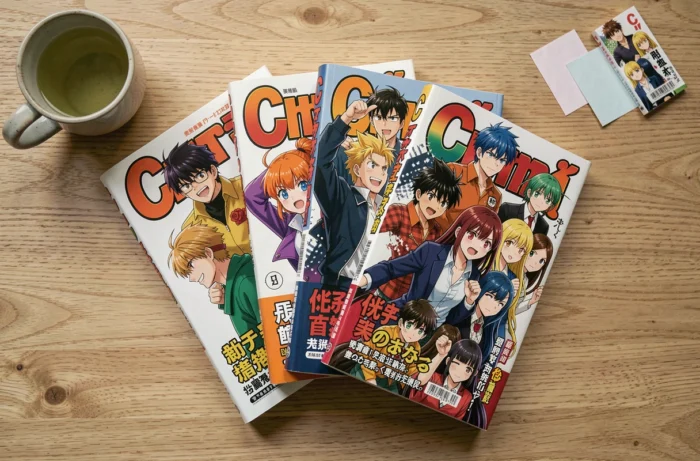
City Hunter and Claymore: two visions of shonen and seinen
Grouping City Hunter and Claymore under the same initial should not obscure the fact that these two mangas target very different readerships and embody two distinct eras of Japanese comics.
City Hunter, the urban shonen of the 1980s
Created by Tsukasa Hojo, City Hunter follows the missions of Ryô Saeba, a private cleaner in Tokyo. The manga alternates between action sequences and gags, a blend of tones that defined a narrative model adopted by many subsequent series. Its anime adaptation amplified its notoriety outside Japan, particularly in France where the animated version (known as Nicky Larson) preceded the discovery of the paper manga for many readers.
City Hunter belongs to a category of shonen that almost no longer exists today: the adult episodic narrative, with a morally ambiguous main character, published in a magazine aimed at young boys.
Claymore, the dark fantasy seinen
Norihiro Yagi built Claymore around half-human warriors fighting demons. The manga stands out for a dark medieval universe where female characters occupy all combat roles, which contrasted with the genre’s codes at its publication. The completed series offers a comprehensive narrative over several volumes, an advantage for readers who prefer to avoid ongoing series.
In contrast, Claymore has never reached the sales figures of shonen giants like Naruto or One Piece. Its reputation has been built through word of mouth and recommendations in specialized bookstores, a circuit that remains crucial for niche seinen in France.
Crying Freeman and the adult C mangas
The name Crying Freeman regularly comes up in discussions about significant seinen. Written by Kazuo Koike (also the author of Lone Wolf and Cub) and illustrated by Ryoichi Ikegami, this manga tells the story of an assassin who cries every time he kills. The narrative blends thriller, eroticism, and martial arts in a decidedly adult register.
This editorial positioning raises a question rarely addressed in recommendation lists: the age classification of C mangas varies significantly from title to title. Card Captor Sakura targets a child audience, City Hunter a teenage readership, Crying Freeman adults. Field feedback diverges on this point when it comes to advising a beginner reader, as the common initial masks considerable content disparities.
French publishers have gradually adopted a logic of segmented collections. Panini, for example, explicitly distinguishes “heritage” mangas from new releases in its offerings, making it easier for readers looking for classic titles like Crying Freeman or City Hunter rather than recent releases.
Contemporary C mangas: beyond the classics
Specialized databases like Manga-News list several dozen series starting with C, the majority of which are recent titles published on digital platforms like Piccoma. This evolution deserves attention.
- C webtoons and digital mangas (like “It’s dangerous outside!”) arrive directly in vertical reading, a format that alters visual storytelling compared to traditional paper manga
- The represented genres are expanding: romance, slice of life, fantasy, social narrative, well beyond the shonen/seinen/shojo triptych that structured the market just a few years ago
- The duration of series varies from one-shots (single volumes, like some titles from the Matière catalog) to long series of several dozen volumes
The French manga market no longer operates solely on a logic of tops and bestsellers. Recommendations by sub-segments (action shonen, psychological seinen, classic shojo) take precedence over overall rankings. For a reader exploring C mangas, this segmentation means they will find titles suited to their specific tastes, provided they look beyond the five or six names that come up everywhere.
Detective Conan, another major series starting with C in its abbreviated version (Conan), illustrates this depth of catalog well. With ongoing publication in Japan and a considerable number of volumes, it is one of the longest series in the history of manga, a fact that simple alphabetical lists do not allow one to grasp.
The letter C, ultimately, functions as a microcosm of manga as a whole: heritage classics coexist with digital novelties, children’s narratives neighbor violent seinen, and completed series coexist with publications ongoing for decades. The real work for the reader is not to find a list, but to identify the genre and tone that suit them among this mass of titles.